AWOL! Em and Chris in South America

Our year long journey to Costa Rica, Equador, Peru, Bolivia, Argentina...

Bolivia crammed into a post
Filed under: Bolivia,Main — sablog at 3:35 pm on Tuesday, October 17, 2006

normal_DSCN1994.JPG

For more pictures of Bolivia: go here.

Warning! On the second photo page there are some disturbing mummy/skeleton pictures. Happy early Halloweeeeeen! I’m not joking, they’re creepy. And I felt bad taking pictures because it seemed very disrespectful, but at the same time….how could I not (you’ll see).

After leaving Puno, we crossed the border into Bolivia by land. I guess different borders are handled different ways. Basically, between Bolivia and Peru there is a very short bridge that spans a shallow, dirty river, and this bridge is “guarded” by maybe one Peruvian border guard and maybe one Bolivian border guard. And by guard I mean more of a people-watcher. If Em and I had wanted to, we could have just strolled on in like the hoards of other people crossing the bridge. But small, innocent mistakes like illegally entering a country have been known to cause trouble later down the road and besides it would have been one less stamp on our passport, and what good is a passport if you don’t get it stamped!…so…we did things officially.

After that, it was on to La Paz and Sucre. We basically only had one night in La Paz and the next evening we were headed off to Sucre. However, we were in La Paz long enough to leave two impressions with me. China Town and dried llama fetuses. La Paz doesn’t have a Chinese district that I know of, but the way the signs and streets and everything are in the tourist district reminded us very much of good old China Town in San Francisco. But yes, the whole China Town similarity is the not so interesting part….llama fetuses, now that is not something you run across every day. There are these vendors, called yatiris (medicine women)….and they sell these mystical items like soaps and beads, herbs, statues and small dried llamas. I really wish I had taken a picture for show and tell, but it would have been rude without buying something and I can’t think of one good use for a llama fetus. I thought about getting some for all my friends and family but they’re just a little too large for stocking stuffers…. It would make a good Nightmare Before Christmas moment, anyway. The actual intended use for these forlorn llamas is as offerings to Paccha Mama (Mother Earth).

I remember most of Bolivia as a big blur……………laPazSucrePotosiUyuniSaaaaaaaaaaaaaaaaalllllllllllaaaaaaaaaaaarrrrandthentheBorder. We basically blasted through the country in less than two weeks. We were lucky to be able to move so quickly. Our first few days in Bolivia we saw on the news that some miners had begun protesting and blockading the roads to the north. As we moved our way south we kept running into travelers that had been delayed by road blocks. Basically as we moved down through the country, all the roads were shutting behind us. Bolivia is the poorest South American country and has continual unrest, so sadly the whole blockade thing is business as usual. Before all the protesting started, we were in La Paz talking to a travel agent about a tour and she was saying that this week was a good one to go because there were no blockades going on!

We visited Sucre briefly. It was one of the cities on our list as possible places to stay. But no real job opportunities presented themselves for Emily, so we just did the tourist thing for two days. It is a pretty city (called the White City because most of the buildings are, well, white) and has one of the most fascinating cemeteries I have ever seen. In this cemetery all the dead are ‘buried’ above ground in these tombs that range from an ornate slot in a wall to giant buildings, depending on the money and influence the family has. You should check out the pictures.

Next was Potosi, where we just stayed the night, enjoyed the breathlessness that comes with being in the highest city in the world, had a MISERABLE shower, almost got robbed the next morning and then it was off to Uyuni. Yes we are left with fond memories of Potosi. About the whole robbing thing. Em and I had all of our stuff and were headed towards the bus station to take off. We hailed a sketchily marked taxi. One block later a guy jumps in and says he’s going to the station too. Em had done some reading and sharing taxis was generally not a good idea. But before we really had time to react, he was in and we were nervously heading to the bus station. That is, until the plain clothes immigration authority stopped us. There was a lot of chatter between the taxi driver and the guy in the seat next to us and the immigration officer about who everyone was, where we were going, blah, blah, blah and then the officer hops in and says please let us go down to the immigration office. At that point Em and I said no way (plain clothes police are forbidden contact with tourists), we jumped out and were yelling “Abre, Abre, Abre!” To the taxi driver to open the trunk (we couldn’t remember the dang word for trunk). Amazingly, he popped the trunk and we took off. Close one.

Our reflexes have changed during the course of the trip. At the beginning, we might have walked right into that situation blindly or not had the presence of mind to react as we did. In the states we practically never had to even pay the slightest attention to our surroundings. Maybe occasionaly late, late at night or in very crowded city situations. Besides having very safe streets, we also had a car which is like another security layer that we never even thought about. Here, there is always the vague threat of petty theft, so our stuff is always in contact with our bodies and never out of our sight. I usually have my hand in the pocket that has my valuables.

We were pretty shaken after that scare with the taxi, but very relieved to be able to board the bus with all of our things with us. As Potosi slipped away, we passed a bus that had stopped on its route toward Potosi and wouldn’t go further. Another road blockaded behind us.

Before us now lay the Salar de Uyuni.

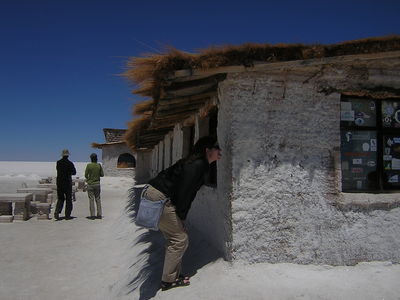
The tours into the Salar consist of a guide/driver, a cook and six merry adventurers crammed into a rangerover or other four wheel drive vehicle that can acommodate (or is forced to accommodate) eight passengers. Then it is off into the wild wilderness of the high desert for three days over mostly dirt roads and some places where the four wheel drive was definately necessary. We were able to hit the road in the dry season. Apparently in the wet season, break downs are a given and tours can go well beyond the intended three days. We only experienced a 10 minute breakdown. It was some rough road but very much worth it. It is hours of driving through landscapes that boggle the mind. The first stage is traveling across the salt flats (Salar) of Uyuni. They go on forever. At points all you can see is white spreading all the way to the mountains in the distance. One of the stops is an island that trully is a freak of nature. Before the Andes formed, the land was submerged underneath the ocean. Plates collided, the Andes popped up, trapped a bunch of water and then formed the salt flats over time. In the middle of the flats is this island that is covered in coral. Now, growing among the coral is a forest of cacti, some of them older than a thousand years old. The combination could not be more strange….an island of coral, thousands of meters in altitude completely surrounded by salt…..replete with cacti. Go figure.

While there was nothing else quite so bizarre as the cactus island, we passed through landscapes of Dr. Seuss and Dahli proportions. It was beautiful and humbling. The sheer power, wildness and desolation imprinted itself within us as we pressed on through deserts that stretched on as far as the eye could see, past volcanoes, lava flows, geysers, fields of boulders spewn by erruptions and carved by wind. I saw and felt the sheer, raw nature of the changing world like I never have before.
Puno and Lake Titicaca

Filed under: Main,Peru — sablog at 10:22 pm on Sunday, October 8, 2006

normal_DSCN1914.JPG

For pictures of Lake Titicaca: click here

You can visit the lake on both the Peruvian and Bolivian sides. We didn’t have time to go to both, so we needed to pick one. We asked a couple people, but the advice seemed about equal, so we decided to go to Puno in Peru because the bus schedule worked out better for us. A great way to plan your travels, huh. It actually turned out really well for us because you can only visit the floating reed islands from Peru and it was one of the most interesting places we have been so far.

Lake Titicaca is the highest commercially navigable lake in the world. It lies at 12,507 feet (3,812 m) above sea level between the border of Peru and Bolivia. It is huge. The Incas believed this lake and one of the islands on the Bolivian side are where the world was created. People live on some of the islands in the middle of the lake, so we took a boat out there to visit their islands.

The first place the boat stops is called Uros. It is a group of about 40 islands made out of reeds and they are floating on the lake. The people have lived there on and off for hundreds of years. They put their huts on boats made from reeds and left the mainland originally to escape conquerors who wanted to enslave them. They cut the reeds from the lake and pile them on top of each other until they are about 5 meters thick. They then anchor their island to the bottom of the lake so it doesn’t float away. It makes sense, but I was surprised at how squishy the ground was and how hard it was to walk around on the island. The only thing I can compare it to is as if you were walking around on a trampoline. Everything on the islands are made out of reeds, their boats, houses etc. Right now people still live on the islands. They have an elementary school on an island, but no high school, so the lucky ones get to go to the mainland for school. The economy of Peru is improving, so many of the inhabitants are moving there anyways. Our guide guessed that in about 10 years the culture will probably disappear because more and more of them are moving back to the shore. Then the islands will probably only exist as a tourist attraction. I felt very lucky to be able to visit it before it is gone. Although, I can’t believe that people can live in that kind of environment.

Depending on the size of the island, there are 2 to 10 families living together. It is very close quarters, so we asked what happens if there is a problem with someone not getting along or doing what they are supposed to do. I don’t know if he was joking or not, but the island president took out a saw and said then they just cut the reeds around their house and let them float away. I guess that’s a literal version of cutting someone off. It is difficult to describe this place. It is just so different from anything or anyplace I have ever been before. Take a look at the pictures for some idea, but it was so much about being there and seeing water 20 feet in any direction.

We went on a reed boat from that island to a different one while some of the island boys sang Andean folk music to us at first. Then they wanted to show off the songs they knew in other languages. They knew a song in French, Japanese (very impressive) and “Twinkle, Twinkle, Twinkle Star” in English 🙂
From there we took the regular boat to a natural island, Taquile, that had a different group of people living on it.

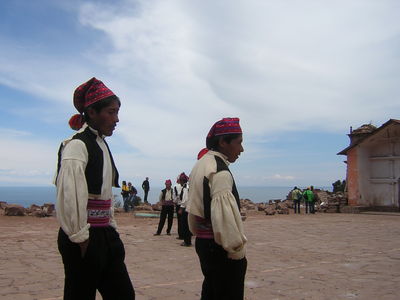
We went on a beautiful walk on a trail created by the Incas hundreds of years ago before we reached the little town. In the pictures you might see the boys wearing what look like sleeping caps. They were introduced by the Spanish conquerors and they still wear them. This group of people is famous for their goods made out of wool. I was a little hungry after our walk and so I went up to a little stand selling various snacks. The girl had all kinds of cookies. Some of them were British or American and I recognized them. Others, were South American and unfamiliar to me. I decided to be a little adventurous and try something new, so I asked her what was the best cookie in Peru. Her answer- Oreos!

Arequipa – Colca Canyon

Filed under: Main,Peru — sablog at 2:14 am on Thursday, October 5, 2006

normal_DSCN1840.jpg

After Machu Picchu and the train back to Ollantaytambo we took the local route back to Cusco in what was going to be a very long day of traveling. There seemed to be something…off…with each segment of the journey. The first little combi we took from Ollantaytambo had a man riding with us who seemed to be in a very bad way. Every movement he made seemed to come with a great deal of pain. The next bus we took was standing room only, when we realized that there were no seats we tried to get off, but a whole wave of people surged onto the bus and we were stuck standing all the way back to Cusco in a very stuffy bus, people packed around us. Amazingly we arrived in Cusco with everything still in our pockets and bags. Once in Cusco, we arranged to take an overnight bus to Arequipa….and what a trip that was. Oi. At any given moment there were three to five people snoring around us. And I mean SNORING. One guy (his wife chimed in with gusto on occasion too) ripped out earth shaking snorts the whole trip, non-stop. Emily had ear plugs and headphones with the volume all the way up and she could still hear the guy. I had nothing and have never felt so claustrophobic in my life. I managed to nod off here and there, but much of the trip was spent in audio hell.

So…we arrived at Arequipa refreshed and ready to tackle a brand new day. Actually, Em fell sick again  with food poisoning. Both times it has been after we’ve eaten at a ‘nicer’ restaurant. Go figure. I firmly believe that this second time she had a weakened immune system due to sustained auditory torture.

Once Em had recovered, we hit the town to explore a little. We went to the main site in the city, Catalina Convent which is this huge complex built over the past 500 years. By the time we got through the convent our feet were pretty tired. They have it set up so that you pretty much have to walk through the entire convent (every room practically). It was impressive, and I have never seen so many kitchens in my life. Every nun had her own living area and kitchen (or two) with a brick oven and grinding stone etc.  There was this huge building that was itself a gigantic kitchen with a well right inside.  I thought that was pretty clever. We didn’t have a guide to explain so…I guess the life of these nuns was cooking and God. Anyway, after the convent we booked a tour to Colca Canyon for the next day and ate dinner in the main plaza. Arequipa has one of the most beautiful plazas that we have seen in South America. Cusco had a great plaza as far as architecture and layout are concerned, but it felt more like a tourist center than a place to relax and enjoy the city. In Arequipa the plaza is very beautiful and is also the center of the city life. People eat in various restaurants that have balconies overlooking the plaza. As the day turns towards evening more and more people start showing up, to hang out in the plaza itself or meet up before heading off to the bars and dance clubs. The city becomes vibrant and very active at night. A couple days later we were hanging out during the evening with some people we met during our tour —Tom (Spanish) and Tsusushi (Japanese). Em and I had an early bus to catch so we had to head back to our hostel around 10:30. The streets were filled with people. We were turning in, but the rest of the city was just getting started.

As for the tour itself, I’ll summarize as much as I can. Emily, myself and Tom sat in the back of the tour bus which was quite uncomfortable because the seats do not recline at all and the tour is basically a lot of driving. It was not kind to our backs. The tour is a two day event, involving a drive through a national reserve were you can see Vequnyas (wild Llamas), Alpacas and Llamas, and Visqatchis, a close relative to Chinchillas (bigger, but just as cute). At one point, you pass through a very high pass which is a really cool looking place. First it’s a great panoramic view of various volcanoes, but what I loved is that everywhere there are these piles of stones that stretch on seemingly forever. Basically the tradition is to come to this point, build a pile of stones as an offering, and make a wish. We stayed in the village (Chivay), went to a hot springs (water was nice but the air was freezing!), watched a good performance of music and dances of the various indigenous groups. They would pull people fom the audience up to dance with them on occasion.  They made Emily get up and dance with them for a bit.  It was difficult enough doing the dance she didn’t know with the guy who knew what he was doing, but then they passed her on to another tourist and went to go get someone else from the audience.  So, the two of them made quite a pair.  Niether of them knew what they were doing and the guy (who is supposed to be the leader) had very little rhythm.  Our whole group cheered her on. never the less.  The next morning we headed out to Colca Canyon, the main focus of the tour.

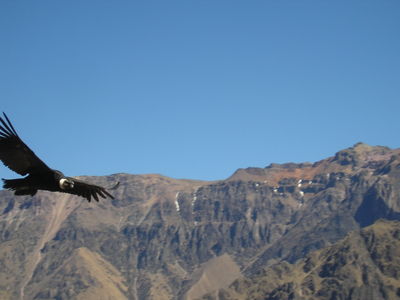
The canyon is deeper at one point than the Grand Canyon. However, the part that we saw wasn’t nearly as impressive as the breadth, variety, color and majesty of the Grand Canyon. The comparisons they made to the Grand Canyon had me expecting something more, but no matter.  From the vista point on the canyon where we were, you could also see the origin of the Amazon, a mountain called Mismi. Which was pretty cool. The main point of going to Colca Canyon is to see condor birds. There is a point called Cruz del Condor where the condors are almost guaranteed to pass by. You arrive early, around 7:30 in the morning, and basically you wait as the day heats up and creates stronger drafts for the condors to fly on. They start low in the canyon and start to rise higher and higher as it gets warmer until they are at the rim of the canyon. At this point everyone gets excited, takes lots of pictures and then the show is over as the condors soar on past us and far up into the sky. The whole process took about two and a half hours for us. Our guide told as that the condors are both curious about the tourists but also have something more sinister in mind, they swoop by (they do this to cattle too) in the hopes that their presence will spook their target into getting distracted and falling down the cliff. There were a couple nutjob tourists that were standing on a precarious point overlooking the canyon. If one of the condors had really took a swing at them, the condors could have gotten a good meal out of the deal.

(Emily) Sometimes the most enjoyable parts of a trip are the little things that you can never plan.  We stopped off for a bathroom and coca tea break at a little rest stop in the middle of nowhere.  But somehow wherever the tourists are, there the local vendors are also.  There was a group of them selling the usual sweaters, scarves, etc. and of course the little kids dressed up in their traditional outfits in order to have their pictures taken by the tourists (they recieve a tip for the service).  There was one little girl of about 4 who didn’t look very interested in doing her job.  She was playing by herself with an orange balloon.  I went up to her and asked how to say balloon in Spanish.  She mumbled something that I didn’t understand, but I guess she decided I would make a good balloon tossing friend even if I didn’t know such obvious things, so she through the balloon at me.  It surprised me because it had a rock inside of it.  The blown up balloon didn’t last long.  I think the rock probably poked a hole in it and it soon deflated, but that didn’t stop this little girl.  She was so excited to toss this balloon/rock back and forth with me.  If she made a good catch I would clap and say “bueno”.  Then she would jump up and down and turn in circles.  Her mom would make occasional attmepts to get her to put the balloon down and get back to “work”, but she kept right on throwing the balloon/rock to me.  Chris finally called me to get back on the bus to leave.  She seemed very dissapointed that I had to go.  I really wished I had a whole packet of balloons to leave with her, but we had a great time while it lasted. 

that was pretty much it. We headed back, stayed the evening in Arequipa and took off the next morning to Puno and lake Titicaca.

Click here for pictures of Mt Mismi, condors, etc.

« Previous PageNext Page »