AWOL! Em and Chris in South America

Our year long journey to Costa Rica, Equador, Peru, Bolivia, Argentina...

South America where art thou? The first days in Argentina

Filed under: Argentina and Uruguay,Main — sablog at 1:31 pm on Saturday, October 28, 2006

We returned from the Salar exhausted and filthy. Dust was everywhere, our clothes and hair were caked with it and our bags now had a very travel worn look. It would have been heaven to crash into a nice, soft bed. However, we had a train that night to the border of Argentina and a bus the next day, so even though we desperately needed a break, it would have to wait.

That night the train took us out of one of the poorest South American countries and into one of the richest. The difference wasn’t apparent the second we crossed the border, but by the time we had reached our destination for the night it felt like we had stumbled out of the wastelands of the Salar and into another world entirely. We had left South America behind and gone to Europe somehow. Argentinians are primarily fair skinned, the buildings are beautiful colonial structures and well cared for, the cars were newer models and very numerous, the streets were clean, there were wi-fi signs in some cafe windows (for Chris that was the clincher – civilization at last!), so it just didn’t feel quite like we were still on the same continent.

The only strange thing is their store hours. I decided to look for some shoes I needed after we ate lunch. That was a big mistake as all the stores were closed by the time we got done. Many places in South America close up shop completely for 1-2 hours at lunch time, so we just figured they would open back up at 3 pm like we were used to. 4 pm rolled around and the stores were still closed. We finally asked someone at our hotel about it and they looked at us like we were the crazy ones trying to shop in the middle of the afternoon. Apparently, the stores close from about 12:30 to 4:30 or 5pm. Everyone goes home and the streets are completely empty. It almost feels like we were in a ghost town or something. But, by evening the streets are flooded with people and all sorts of activity.

The next day we moved on to the city of Mendoza. It was an amazing place. We had heard good things about it, so it was one of the places on our list to consider staying until July. It is Spring right now, so the temperature was hovering around 80 F. All the streets are lined with shady green trees that stretch over to the other side. The side walks are paved with bricks and tiles instead of concrete and there are Spanish style plazas and parks everywhere with fountains and children playing and people eating ice cream. They eat a lot of ice cream in Mendoza. It seems like there is an ice cream shop on every other corner. I was in heaven. It was just such a pleasant peaceful place to be.

I looked into staying and working there, but we found that the school year is on a different schedule. School starts in March and goes until the beginning of December. So, they are about to finish out their year before their summer vacation. From what I have learned since we have been here, Argentinians are big on their summer vacation. Nothing gets done the entire month of January. So, the schools said I would have a guaranteed job in March, and maybe starting in February, but nothing until then. March is a long time from now and I’m not too good at just sitting around twiddling my thumbs. So, we decided Cuenca is probably our best bet for a place to return to.

I still didn’t have the shoes I needed since all the stores in Salta were closed. So, I tried again in Mendoza. These stores were actually open, but they had a system that I didn’t understand at first. Shoe stores have very large display windows with tons of shoes crammed inside. There are hardly any shoes actually inside the store. It took me a while to realize that you look outside. Then, if there is something you want to try on you have to go inside, bring the clerk outside and point to which shoe you would like. Then they will go get it – or sort of. They never seemed to have the shoe I wanted in my size. So, they would bring me “similar” shoes. Similar could mean anything. Sometimes they were completely different colors, styles, or purposes than what I had originally pointed out. I finally gave up on shoe shopping.

(Chris) Since Mendoza is THE major wine region of the South America, we went on a wine tasting tour. The Argentinians are very proud of their wine, boasting that it is better than Chile’s, and in fact one of Chile’s major wineries is in Mendoza ironically enough. Apparently Chile has better connections with the United Sates and Europe and so has established a strong wine trade while Argentina has not been able to get “in the game” with their wine. Argentinian wine is all over South America, but apparently Chile has been better at getting into the richer markets. The wine tour was interesting, but the best part came at the end of the tour. The tour ends at a restaurant. I have never seen a restaurant like this one, I think it’s sole purpose is to serve large groups of people and it probably does its main business with these tour groups. There are several small buildings, each with its own dining area, kitchen, chef and wait staff. We walked into our reserved room and before us was the most amazing spread I have ever seen in my life. It was beautiful. And good! The lunch lasted for a few hours. While we snacked on what was laid out, they brought out hot dishes, soup, and finally desert. It was quite luxurious and very tasty.

We chilled in Mendoza for several days. We were both very tired from the Salar trip and our whirlwind tour of Bolivia, so we really needed the rest. Or I did at least, I was snappy and grumpy and tired of traveling or doing anything. If it had been up to me, in Mendoza I would have just sat in the hotel room all day and read books or something totally boring like that. Emily and my travel speeds and preferences are quite different and so it tends to cause tension at various points….and this was one of them. Emily has a very different idea of what resting is…somehow shopping and sight-seeing and ‘doing things’ are part of her definition, while sitting around like a useless, unmoving lump of a person is more closer to my definition of resting. It pains Emily to be in a new place and do nothing. While I may not like it all the time, it’s good because we see a whole lot more of the places then I would on my own. But it can be a bit much for me sometimes. Oh well. So, in Mendoza we did a little of Chris type resting and a lot of Emily type resting much to my dismay :p

I have pictures of the amazing lunch on my camera, but all the batteries are dead right now so I can’t transfer them at the moment. I’ll let everyone know when we the pictures have been added. I’ll probably just include them when we do our next post. So, until next time!
Bolivia crammed into a post

Filed under: Bolivia,Main — sablog at 3:35 pm on Tuesday, October 17, 2006

normal_DSCN1994.JPG

For more pictures of Bolivia: go here.

Warning! On the second photo page there are some disturbing mummy/skeleton pictures. Happy early Halloweeeeeen! I’m not joking, they’re creepy. And I felt bad taking pictures because it seemed very disrespectful, but at the same time….how could I not (you’ll see).

After leaving Puno, we crossed the border into Bolivia by land. I guess different borders are handled different ways. Basically, between Bolivia and Peru there is a very short bridge that spans a shallow, dirty river, and this bridge is “guarded” by maybe one Peruvian border guard and maybe one Bolivian border guard. And by guard I mean more of a people-watcher. If Em and I had wanted to, we could have just strolled on in like the hoards of other people crossing the bridge. But small, innocent mistakes like illegally entering a country have been known to cause trouble later down the road and besides it would have been one less stamp on our passport, and what good is a passport if you don’t get it stamped!…so…we did things officially.

After that, it was on to La Paz and Sucre. We basically only had one night in La Paz and the next evening we were headed off to Sucre. However, we were in La Paz long enough to leave two impressions with me. China Town and dried llama fetuses. La Paz doesn’t have a Chinese district that I know of, but the way the signs and streets and everything are in the tourist district reminded us very much of good old China Town in San Francisco. But yes, the whole China Town similarity is the not so interesting part….llama fetuses, now that is not something you run across every day. There are these vendors, called yatiris (medicine women)….and they sell these mystical items like soaps and beads, herbs, statues and small dried llamas. I really wish I had taken a picture for show and tell, but it would have been rude without buying something and I can’t think of one good use for a llama fetus. I thought about getting some for all my friends and family but they’re just a little too large for stocking stuffers…. It would make a good Nightmare Before Christmas moment, anyway. The actual intended use for these forlorn llamas is as offerings to Paccha Mama (Mother Earth).

I remember most of Bolivia as a big blur……………laPazSucrePotosiUyuniSaaaaaaaaaaaaaaaaalllllllllllaaaaaaaaaaaarrrrandthentheBorder. We basically blasted through the country in less than two weeks. We were lucky to be able to move so quickly. Our first few days in Bolivia we saw on the news that some miners had begun protesting and blockading the roads to the north. As we moved our way south we kept running into travelers that had been delayed by road blocks. Basically as we moved down through the country, all the roads were shutting behind us. Bolivia is the poorest South American country and has continual unrest, so sadly the whole blockade thing is business as usual. Before all the protesting started, we were in La Paz talking to a travel agent about a tour and she was saying that this week was a good one to go because there were no blockades going on!

We visited Sucre briefly. It was one of the cities on our list as possible places to stay. But no real job opportunities presented themselves for Emily, so we just did the tourist thing for two days. It is a pretty city (called the White City because most of the buildings are, well, white) and has one of the most fascinating cemeteries I have ever seen. In this cemetery all the dead are ‘buried’ above ground in these tombs that range from an ornate slot in a wall to giant buildings, depending on the money and influence the family has. You should check out the pictures.

Next was Potosi, where we just stayed the night, enjoyed the breathlessness that comes with being in the highest city in the world, had a MISERABLE shower, almost got robbed the next morning and then it was off to Uyuni. Yes we are left with fond memories of Potosi. About the whole robbing thing. Em and I had all of our stuff and were headed towards the bus station to take off. We hailed a sketchily marked taxi. One block later a guy jumps in and says he’s going to the station too. Em had done some reading and sharing taxis was generally not a good idea. But before we really had time to react, he was in and we were nervously heading to the bus station. That is, until the plain clothes immigration authority stopped us. There was a lot of chatter between the taxi driver and the guy in the seat next to us and the immigration officer about who everyone was, where we were going, blah, blah, blah and then the officer hops in and says please let us go down to the immigration office. At that point Em and I said no way (plain clothes police are forbidden contact with tourists), we jumped out and were yelling “Abre, Abre, Abre!” To the taxi driver to open the trunk (we couldn’t remember the dang word for trunk). Amazingly, he popped the trunk and we took off. Close one.

Our reflexes have changed during the course of the trip. At the beginning, we might have walked right into that situation blindly or not had the presence of mind to react as we did. In the states we practically never had to even pay the slightest attention to our surroundings. Maybe occasionaly late, late at night or in very crowded city situations. Besides having very safe streets, we also had a car which is like another security layer that we never even thought about. Here, there is always the vague threat of petty theft, so our stuff is always in contact with our bodies and never out of our sight. I usually have my hand in the pocket that has my valuables.

We were pretty shaken after that scare with the taxi, but very relieved to be able to board the bus with all of our things with us. As Potosi slipped away, we passed a bus that had stopped on its route toward Potosi and wouldn’t go further. Another road blockaded behind us.

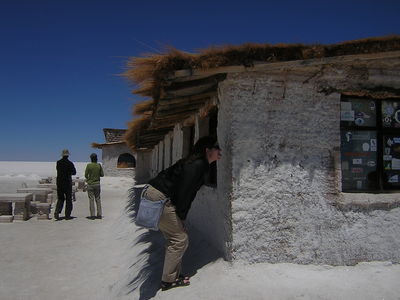
Before us now lay the Salar de Uyuni.

The tours into the Salar consist of a guide/driver, a cook and six merry adventurers crammed into a rangerover or other four wheel drive vehicle that can acommodate (or is forced to accommodate) eight passengers. Then it is off into the wild wilderness of the high desert for three days over mostly dirt roads and some places where the four wheel drive was definately necessary. We were able to hit the road in the dry season. Apparently in the wet season, break downs are a given and tours can go well beyond the intended three days. We only experienced a 10 minute breakdown. It was some rough road but very much worth it. It is hours of driving through landscapes that boggle the mind. The first stage is traveling across the salt flats (Salar) of Uyuni. They go on forever. At points all you can see is white spreading all the way to the mountains in the distance. One of the stops is an island that trully is a freak of nature. Before the Andes formed, the land was submerged underneath the ocean. Plates collided, the Andes popped up, trapped a bunch of water and then formed the salt flats over time. In the middle of the flats is this island that is covered in coral. Now, growing among the coral is a forest of cacti, some of them older than a thousand years old. The combination could not be more strange….an island of coral, thousands of meters in altitude completely surrounded by salt…..replete with cacti. Go figure.

While there was nothing else quite so bizarre as the cactus island, we passed through landscapes of Dr. Seuss and Dahli proportions. It was beautiful and humbling. The sheer power, wildness and desolation imprinted itself within us as we pressed on through deserts that stretched on as far as the eye could see, past volcanoes, lava flows, geysers, fields of boulders spewn by erruptions and carved by wind. I saw and felt the sheer, raw nature of the changing world like I never have before.

Puno and Lake Titicaca

Filed under: Main,Peru — sablog at 10:22 pm on Sunday, October 8, 2006

normal_DSCN1914.JPG

For pictures of Lake Titicaca: click here

You can visit the lake on both the Peruvian and Bolivian sides. We didn’t have time to go to both, so we needed to pick one. We asked a couple people, but the advice seemed about equal, so we decided to go to Puno in Peru because the bus schedule worked out better for us. A great way to plan your travels, huh. It actually turned out really well for us because you can only visit the floating reed islands from Peru and it was one of the most interesting places we have been so far.

Lake Titicaca is the highest commercially navigable lake in the world. It lies at 12,507 feet (3,812 m) above sea level between the border of Peru and Bolivia. It is huge. The Incas believed this lake and one of the islands on the Bolivian side are where the world was created. People live on some of the islands in the middle of the lake, so we took a boat out there to visit their islands.

The first place the boat stops is called Uros. It is a group of about 40 islands made out of reeds and they are floating on the lake. The people have lived there on and off for hundreds of years. They put their huts on boats made from reeds and left the mainland originally to escape conquerors who wanted to enslave them. They cut the reeds from the lake and pile them on top of each other until they are about 5 meters thick. They then anchor their island to the bottom of the lake so it doesn’t float away. It makes sense, but I was surprised at how squishy the ground was and how hard it was to walk around on the island. The only thing I can compare it to is as if you were walking around on a trampoline. Everything on the islands are made out of reeds, their boats, houses etc. Right now people still live on the islands. They have an elementary school on an island, but no high school, so the lucky ones get to go to the mainland for school. The economy of Peru is improving, so many of the inhabitants are moving there anyways. Our guide guessed that in about 10 years the culture will probably disappear because more and more of them are moving back to the shore. Then the islands will probably only exist as a tourist attraction. I felt very lucky to be able to visit it before it is gone. Although, I can’t believe that people can live in that kind of environment.

Depending on the size of the island, there are 2 to 10 families living together. It is very close quarters, so we asked what happens if there is a problem with someone not getting along or doing what they are supposed to do. I don’t know if he was joking or not, but the island president took out a saw and said then they just cut the reeds around their house and let them float away. I guess that’s a literal version of cutting someone off. It is difficult to describe this place. It is just so different from anything or anyplace I have ever been before. Take a look at the pictures for some idea, but it was so much about being there and seeing water 20 feet in any direction.

We went on a reed boat from that island to a different one while some of the island boys sang Andean folk music to us at first. Then they wanted to show off the songs they knew in other languages. They knew a song in French, Japanese (very impressive) and “Twinkle, Twinkle, Twinkle Star” in English 🙂
From there we took the regular boat to a natural island, Taquile, that had a different group of people living on it.

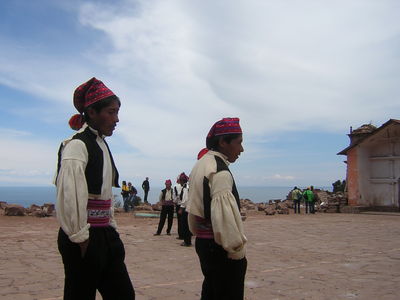
We went on a beautiful walk on a trail created by the Incas hundreds of years ago before we reached the little town. In the pictures you might see the boys wearing what look like sleeping caps. They were introduced by the Spanish conquerors and they still wear them. This group of people is famous for their goods made out of wool. I was a little hungry after our walk and so I went up to a little stand selling various snacks. The girl had all kinds of cookies. Some of them were British or American and I recognized them. Others, were South American and unfamiliar to me. I decided to be a little adventurous and try something new, so I asked her what was the best cookie in Peru. Her answer- Oreos!

Next Page »