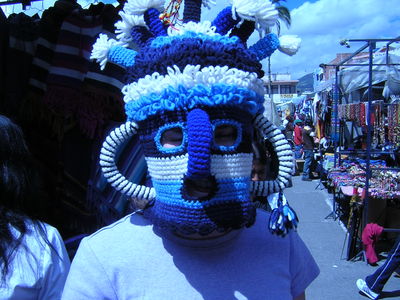
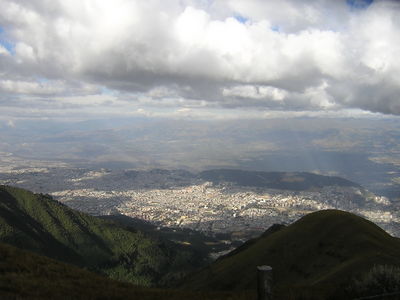
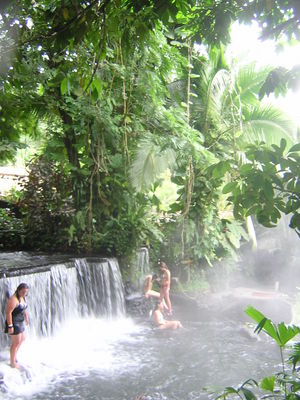
Update: here are some pics of Tortuguero.
The movies are nothing exciting, just some footage of the boat ride just to show the jungle and they take a while to load.
Be forewarned, this is a long post.
A lot has happened in one week. We finished our four days of Spanish school which was both intense and a lot of fun. I’m surprised the difference that one week can make. Being in full immersion Spanish instruction really gets the brain kicked into high gear. I was in a class with three German speaking students so I never really had anyone to talk in English to. It was pretty much Spanish or nothing, which was good. I can understand a lot more Spanish now then when the week started, of course I’m still very much a beginner and Emily even more so, but in general we can get basic communication across with the most necessary aspects of life. We’ve become more comfortable with speaking bad Spanish in order to work towards better Spanish. So that’s good. I’m hoping school in Ecuador will really get us prepared for the rest of the trip. My speaking skills are what really need work….I understand a fair amount, but when trying to put my own thoughts or questions into words, it’s tough.
But yeah, CRLA (the Spanish School) was great. They really take good care of their students with lots of amenities and services to help students with their stay in Costa Rica. We took dance lessons and cooking lessons after the language lessons were done. We met a lot of people from all over. Quite a few people from the states, a ton from Germany. It was a good week.
On Friday, we went down to Tortuguero – a town and national park that is the center of a major conservation effort in Latin America to protect various types of sea turtles, mainly the green sea turtle. Originally we had not intended to go to the Carribean side of Costa Rica, but Emily found out that the turtle nesting season is at its peak right now, presenting a unique opportunity. So off we went!
We knew that a group of people from CRLA were also going, five Germans girls and one lucky Dutch guy, and we they happened to be taking the same bus as us. We and the group of other CRLA students were staying at the same hotel and actually went on to do both activities in Tortuguero together. We hung out together some, but the Germans seemed a bit standoffish as a group. As individuals they were all pretty friendly but as a group they would go back to speaking German to the exclusion of us and Walter (he could understand some German but didn’t speak it too well). I think one of the girls did not speak English very well, so that probably played a part in it.
When we first got on the bus in San Jose, the driver warned the passengers to keep their bags close rather than storing them in the overhead racks. Apparently the Caribbean areas tend to be a little more shady. A fact I found out firsthand at the end of the line. We arrived at the bus station and were waiting for the other passengers to disembark. A couple of younger guys stopped right next to me and were looking back towards the bus and saying something about a problem with someone’s bags or some such. One of the guys was pressed up somewhat close to me. Something caused me to reach down towards my pocket and I encountered the guys hand!! I kind of slapped it out of the way then the two of them quickly moved out of the bus. Their problem of great concern had, apparently, suddenly vanished. Luckily my wallet was still in my pocket.
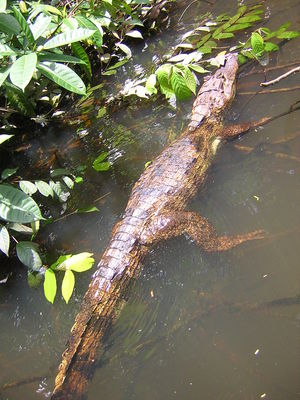
And the adventures continued. The trip to Tortuguero involves a boat trip down a small river. Along the way we saw a large crocodile with it’s mouth gaping open. He closed it when we got closer enough to take pictures, so rude. We also saw a couple howler monkeys, a fresh water turtle, a sloth and some egrets along the way as well.
Tortuguero is a small little village set above Tortuguero National Park, a 30km strip of land that is entirely surrounded by water – fresh on one side and the sea on the other. You can walk through the village in probably ten or fifteen minutes. It’s a tiny place that depends almost entirely on the tourism generated by the national park. The locals that speak English have a heavy Caribbean accent, “mon”.
When we got off the boat and were immediately met by a very official looking man named Roberto. He gave us some instructions about where to go and how the canoe and turtle watching activities are organized. He was standing in front of a tour office, so it looked like he was part of that operation. He then took the group of us to the place we were staying, helped us check in and told us to meet him at the table outside so we could decide if we wanted to join him on any of the tours he offered (you CAN’T go onto the beach at night to see the turtles without a guide, so we had to hire someone). Everything about him seemed legit, well organized, he spoke great English. He even helped us get some money changed so we could pay him for the canoe trip and the turtle watching we were going to do the next day. He told us he would meet us back at our hotel the next day at 9:50 to take us on the canoe.
Next day the clock hits 9:50 – no Roberto…That’s fine, we thought, we’re probably be on island time now. 10:00 – no Roberto. 10:05 and then we asked the lady who owns the hotel where we could find him. There were 2 guys hanging around, so one of them took us to the park entrance thinking he might be there and the other went off to look at Roberto’s house for him.
He was not at the park entrance. At 10:30 or so he finally showed up looking like he had just woken up and then he told us unfortunately he has other matters to deal with. He wanted us to go with this other guy. So we did. The other guy was very nice and full of information about his town, but he was not a naturalist and knew only a little about the plants and animals we saw. The canoe ride itself pretty cool, they take you down some of the canals that go through the jungle. At first we were in very wide canyos (creeks) that were big enough for some of the large lodges to bring their big tour-type boats down, needless to say we didn’t see a whole lot while in the bigger canyos. However, eventually we went down a small canal that could only be reached by canoe. We saw a family of howlers, the little babies were cute, a wild turkey – which was very beautiful compared to the ones in California, a lot of fresh water turtles and some caymans. The caymans were fascinating, they were not afraid of the canoe at all. We paddled up to one and the canoe was practically touching it but it only flicked it’s tail once. Apparently they do not have any natural predators. The only thing that harms them, of course, is humans. Mostly the motorboats which will cut them with the propeller. There are also manatees in these waters but they only come to the surface very early in the morning and very late at night because of the dangers from boats, so we didn’t see any.
Out on the canoe there were times when it was HOT. The humidity plus the moderate heat really makes things sticky. There were frequent breezes, luckily, otherwise it would have been a very uncomfortable trip. I’m glad we were able to make a jungle trip up in Costa Rica where the climate is a bit cooler. We have that option in Ecuador as well, but I think we’ll pass. 90-100 degrees Fahrenheit plus almost 100% humidity in places is pretty much a lose-lose situation.
After returning from our trip, Em and I walked along the beach to see if there was evidence of the turtles coming to shore. Sure enough, there were a number of turtle tracks leading higher up to the beach. What was sad however, is that with almost every turtle nest we could see, there was evidence of them being dug up. Even after we had crossed over into the national park, there were signs of egg poaching. I’m sure it decreases the further you go into the park, but it was disconcerting. If there was a fresh nest, it was either completely dug up, or there would be stick holes in it where the locals had been probing for eggs. At times there would be broken turtle eggs strewn around the area close to the nest. The mindset of the people here is that the turtles have always come here in plentiful numbers and that they always will. Luckily the killing of turtles has been cut back significantly, but it was evident from our long walk on the beach that even after conservation efforts have been ongoing for 50 years, some of the same mindset still remains. We found out later that there is only one official ranger that patrols the 30km stretch of beach. There are other groups that are actively involved in protecting certain stretches of beach, primarily CCC (www.cccturtle.org) which has been active in Tortuguero since 1959. But there is only so much they can do.
That morning, after we had figured out the whole canoe situation, Roberto told us that we had to meet him at our hotel at 5:30 so he could tell us what time we would be able to see the turtles. The park doesn’t want everyone on the beach at once, so each group gets a schedule. Roberto pointedly looked at Emily and said that we must all please be on time (this was right after he was 40 minutes late for our canoe trip). HA. So, at 5:30 we are all sitting there waiting for him – no Roberto, 5:45 – no Roberto, 6pm – no Roberto. Finally, at 6:15 we were all pretty fed up with this guy and feeling a little foolish about ourselves for trusting him and giving him the payment for the trips the day before. Thank goodness one of the other people in the group had seen him hanging out at a house earlier that day, so they went back to see if he was still there, and yes, they found him completely drunk and maybe more. They demanded our money back. He wouldn’t do it, but he did manage to stumble out of the house, down the street and find someone else who would take us on the turtle trip
I guess that is the advantage of being in a town of 800 people. You can’t hide for very long. If it had been a larger town, we would have just been scammed. Luckily Roberto is either not very clever or a well-intentioned person with a drinking problem. I think it’s more of the later, because after we hunted him down he did organize the trips as promised. If he was a complete scammer our money would have been totally gone and he would have vanished.
So, ultimately we got to see the turtles as was planned. And thank goodness, because it was amazing. Our group of ten people, plus a little village dog that decided to go turtle watching too, walked along about a 1km stretch of pitch dark jungle with only the tour guide and her flashlight showing us the way. All around us was the noise of the forest, a couple of times along the trail we some some phosphorescent bugs. We had to keep up with the guide though, so we couldn’t stop and see what they were. As we approached the beach, the guides switch to red lights which are used to avoid frightening the turtles. Once we hit the beach, it is basically a lot of waiting around. The turtles take 2 hours to dig out the nest, lay the eggs and cover it up. The first part of the cycle, when the turtles are coming out of the ocean and begin digging their nest is the most crucial, and they cannot be disturbed at that time otherwise they will go back into the ocean and abort their eggs. We were lucky when we first arrived because one turtle had just completed her nest and was headed back towards the ocean. So we just walked along next to the turtle as it headed for the ocean and watched it go into the sea. At one point the dog suddenly noticed the monstrous turtle and begin barking excitedly. The turtle totally ignored it, but the guide quickly shooed the dog away. Ridiculous, a ten pound dog trying to intimidate a 500 pound turtle. After the few minutes of excitement, we waited around. We were just standing about in the dim moonlight talking to each other for about 15 or 20 minutes when they called us to come over. What we didn’t realize is that we had been standing about 20 feet away from a turtle that was building her nest whilst we chatted, totally oblivious. So when the turtle has formed the nest, basically they are going to lay their eggs and nobody is going to do a thing to stop it. The guides bring the groups over and they might move a flipper so we can see the eggs laying. At this time the CCC people also do their tagging, measuring, etc because the turtle is not going anywhere until she has done her duty. They get manhandled a bit, but apparently it is better for them in the long run because the more we can track and appreciate them, the more we’ll be able to conserve them. So we watched the turtle lay her eggs and pat down her nest, and then it was time to go. The whole process is completely incredible, instinct brings them back to the same shores they were born in, almost 30 years later. Hopefully the conservation efforts will be successful and remain ambitious. They are in the process of establishing a natural, protected corridor through four or five central american countries. Hopefully the countries can cooperate, because that is a fantastic goal.
Well, there was a little more that happened in Tortuguero, but I need to wrap this up. The drive back was very beautiful. In fact every drive we have been on has been beautiful. Basically, as soon as you leave San Jose you are surrounded by lush green forests and misty mountains, without exception everywhere we’ve gone, the scenery is stunning.